Heating problems
Furnace Blowing Cold Air: What to Record
Write down whether the air feels cool only at startup, after heating stops or throughout the call for heat.
Read the guide →
A homeowner library for the problems that show up between seasons, before a service visit and when comparing proposals.
☎ Call (844) 625-3202Write down whether the air feels cool only at startup, after heating stops or throughout the call for heat.
Read the guide →
Note when the thermostat calls, when airflow begins and when the system stops.
Read the guide →
Is the thermostat blank, is the display active without a heat response, or does equipment start and then stop?
Read the guide →
Describe whether the sound seems to come from the furnace cabinet, a nearby duct or a distant register. Note whether it occurs before airflow, as the blower starts, during operation or as the system stops.
Read the guide →
People describe odors differently, and a website cannot distinguish dust, electrical overheating or another source from a short message.
Read the guide →
Record the filter size, product type, installation date and approximate operating use.
Read the guide →
A blower can run at a different point in the sequence from the heating components.
Read the guide →
Water near a furnace may come from connected equipment or a nearby route rather than the first component it touches.
Read the guide →
A message mentioning a pressure switch does not by itself prove that the switch is the failed part.
Read the guide →
A furnace that begins a heating sequence and then stops may lead an online search toward a flame sensor.
Read the guide →
Write down the thermostat setting, room temperature and how the temperature changes over time.
Read the guide →
Note whether ice is visible on an accessible line, the indoor equipment or another location, without removing panels.
Read the guide →
Describe where water first appears: beneath the air handler, along a ceiling, at a drain fitting or elsewhere.
Read the guide →
Record whether the indoor blower, outdoor equipment or thermostat call ends first if that can be observed safely.
Read the guide →
Note where the buzzing seems to come from and whether the outdoor fan is visibly moving.
Read the guide →
Record when the interruption occurs: immediately when cooling is requested, after a period of operation or at an apparently unrelated time.
Read the guide →
Note when power was lost, when it returned and what the thermostat displays afterward.
Read the guide →
Note whether the smell appears only at startup, continues through cooling or remains when the system is off.
Read the guide →
A rattle, buzz, squeal or impact can mean different things to different listeners.
Read the guide →
A replacement comparison is more useful when it includes what is actually wrong with the existing system and what the repair would achieve.
Read the guide →
Air from a heat pump can feel different from air supplied by a gas furnace.
Read the guide →
Note the outdoor conditions, the thermostat display and whether the equipment returns to normal heating after the event.
Read the guide →
Note the room temperature, setpoint, outdoor conditions and whether the thermostat recently changed its schedule.
Read the guide →
Record the thermostat setting, room-temperature trend and outdoor conditions rather than relying only on how warm the register feels.
Read the guide →
A proposal may use the term when discussing the relationship between a building’s heating requirement and heat-pump capacity, or when considering operating cost and backup control.
Read the guide →
A home’s current heating and cooling requirements depend on more than its floor area or the label on the existing equipment.
Read the guide →
Note whether water comes from the indoor unit, a wall route or another location and whether the issue occurs during cooling or after shutdown.
Read the guide →
Describe the indoor-unit model, selected mode, displayed temperature and any error message.
Read the guide →
Record whether the odor appears at startup, during cooling, after a long period without use or throughout the room.
Read the guide →
Tell the provider how many heads are installed, which are affected and whether they share an outdoor unit.
Read the guide →
Record the outdoor weather, indoor comfort and whether the problem affects the whole home. Note the selected fan and cooling modes using normal controls.
Read the guide →
Describe whether the concern is a clammy feeling, visible condensation or a measured humidity reading.
Read the guide →
Record the cooler location, any existing furnace and ducts, and the rooms served by each arrangement.
Read the guide →
Winter preparation depends on the cooler, water arrangement, location and manufacturer instructions.
Read the guide →
Note a power interruption, battery replacement, thermostat installation or HVAC service.
Read the guide →
Record the displayed message, setpoint and room-temperature trend.
Read the guide →
Record the thermostat reading and the comparison meter’s location, time and conditions.
Read the guide →
Record the thermostat and HVAC model information from existing documents and identify the functions the new control must operate.
Read the guide →
Describe which upstairs and downstairs spaces differ and whether the gap changes during the day, at night or with doors closed.
Read the guide →
Note the room’s use, doors, supply outlets, return path and any recent changes.
Read the guide →
Record whether flow seems weak at every register or only along a particular room or floor. Note the operating mode and whether the pattern changed after filter replacement, renovation or service.
Read the guide →
Note whether the sound begins at startup, changes with fan speed or appears only when certain doors are shut.
Read the guide →
Ask for the identified fault, the supported repair scope and any uncertainty about other components.
Read the guide →
A furnace replacement quote may include much more than the appliance.
Read the guide →
A maintenance appointment and a no-heat diagnosis have different objectives.
Read the guide →
Ask whether each quote covers only the outdoor unit or also the indoor coil, air handler or other required components.
Read the guide →
Dust, weak airflow or an uncomfortable room can prompt a duct assessment, but they do not prove that a particular joint is leaking.
Read the guide →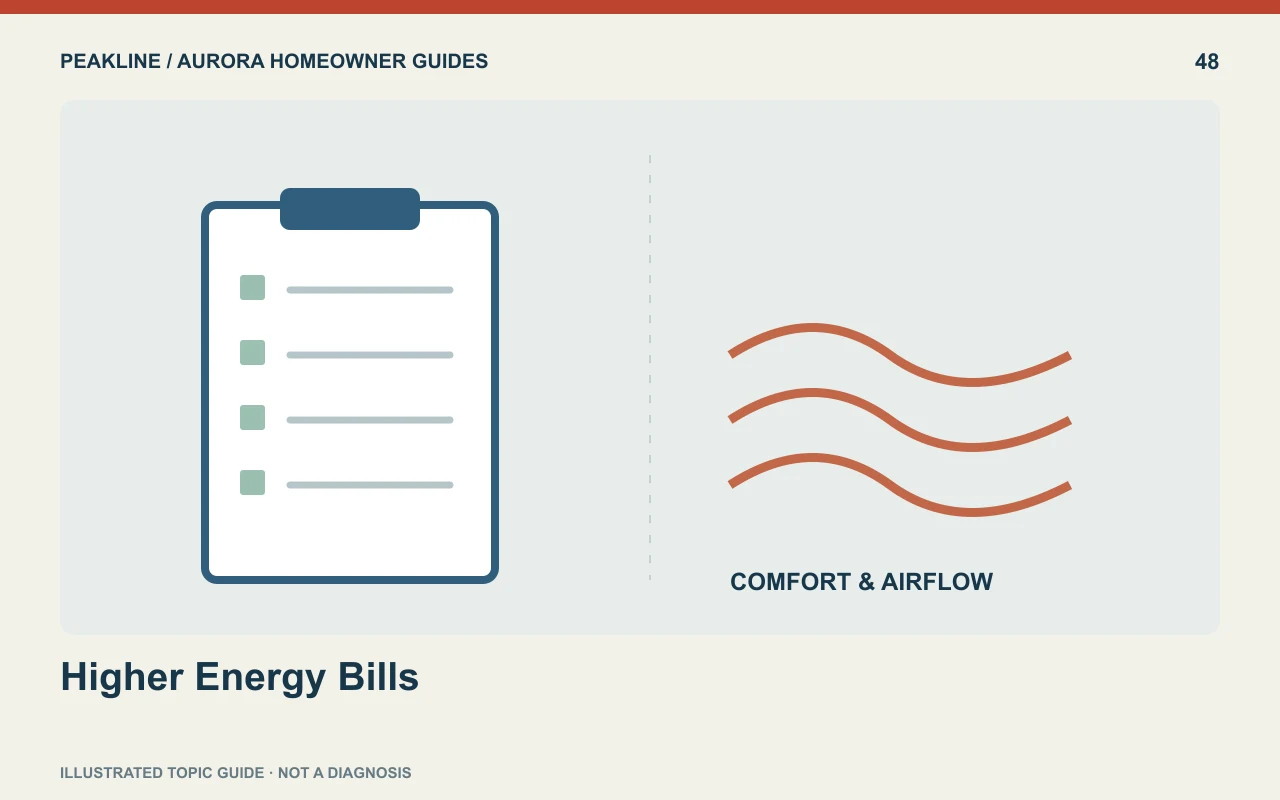
Look at energy consumption as well as the amount charged.
Read the guide →
Gather model and serial information, installation documents, service invoices and any relevant warranty records.
Read the guide →
Write the complaint or project objective at the top of the comparison.
Read the guide →The PeakLine editorial team writes them for homeowners in Aurora and nearby Colorado cities. Each guide starts from a real problem people search for, such as a furnace blowing cold air or a mini-split leaking water, and explains what to record and what to ask. The guides are general information and are checked against official sources linked on the page.
No, a guide cannot name the failed part in your system. It explains the usual causes behind a symptom and the safe checks you can make, such as the thermostat setting or the filter. A technician has to test the equipment to find the actual fault and give you a written repair price.
Call (844) 625-3202 and you will be connected with an independent local HVAC provider who serves your area. Have the symptom, the type of system and your address ready, and ask about the visit fee and availability. Each guide also links the matching service page so you can read what that service usually includes.
Have your address, equipment details and a short description of the problem ready. Confirm current provider availability when you call.